Vertical Storage Ideas for Small Kitchens That Lack Cabinets
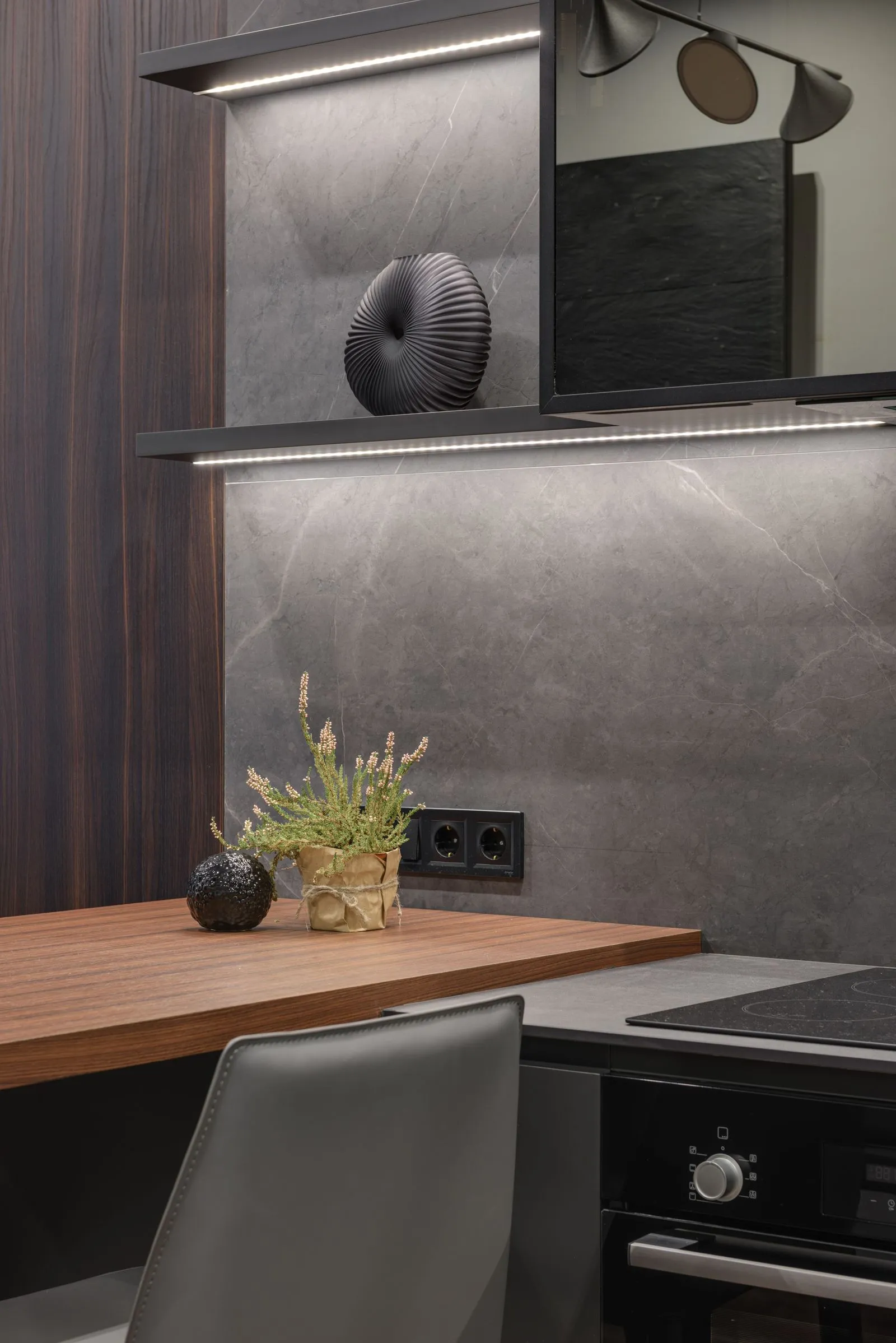
Three cabinets and a stretch of open wall. That is the entire kitchen in a lot of studios and older apartments, and it fills up fast: pots in the one deep cabinet, plates in the other, and nowhere left for the cutting boards, the spice jars, or the four mixing bowls that came with the apartment’s starter set. Buying another shelf unit just eats floor space the kitchen does not have.
The fix is not more furniture. It is the wall itself, and specifically the six or seven vertical feet of it that runs from countertop to ceiling doing absolutely nothing right now. A kitchen with two cabinets can still hold as much as a kitchen with six, once that space gets treated as storage instead of blank drywall.
Map the dead wall zones first
Before mounting anything, walk the kitchen and mark every stretch of open wall between 18 inches above the counter and the ceiling. Most small kitchens have at least three: the run beside the stove, the strip above the counter where a backsplash sits with nothing on it, and the gap above the fridge or above the cabinets that stops a foot short of the ceiling.
Measure each zone in inches, not just “eyeball big enough.” A 24-inch run fits two 12-inch shelf brackets. A 36-inch run over a stove fits a full utensil rail. Knowing the exact width before shopping stops the common mistake of buying a shelf that is 4 inches too long for the only wall that had room.
Rank the zones by reach. Anything within arm’s length of the stove or the counter should hold what gets used daily — oils, everyday dishes, cooking utensils. Anything requiring a step stool, like the gap above the fridge, should hold what gets touched once a month. That single sorting rule decides what goes where in every section below.
Open shelving: heights and weight limits
A run of open shelves is the highest-capacity option for the least wall space, because it stacks storage in layers instead of spreading it sideways. Standard spacing is 10 to 12 inches between shelves for plates and bowls, and 14 to 16 inches for anything with height, like cereal boxes or a stand mixer.
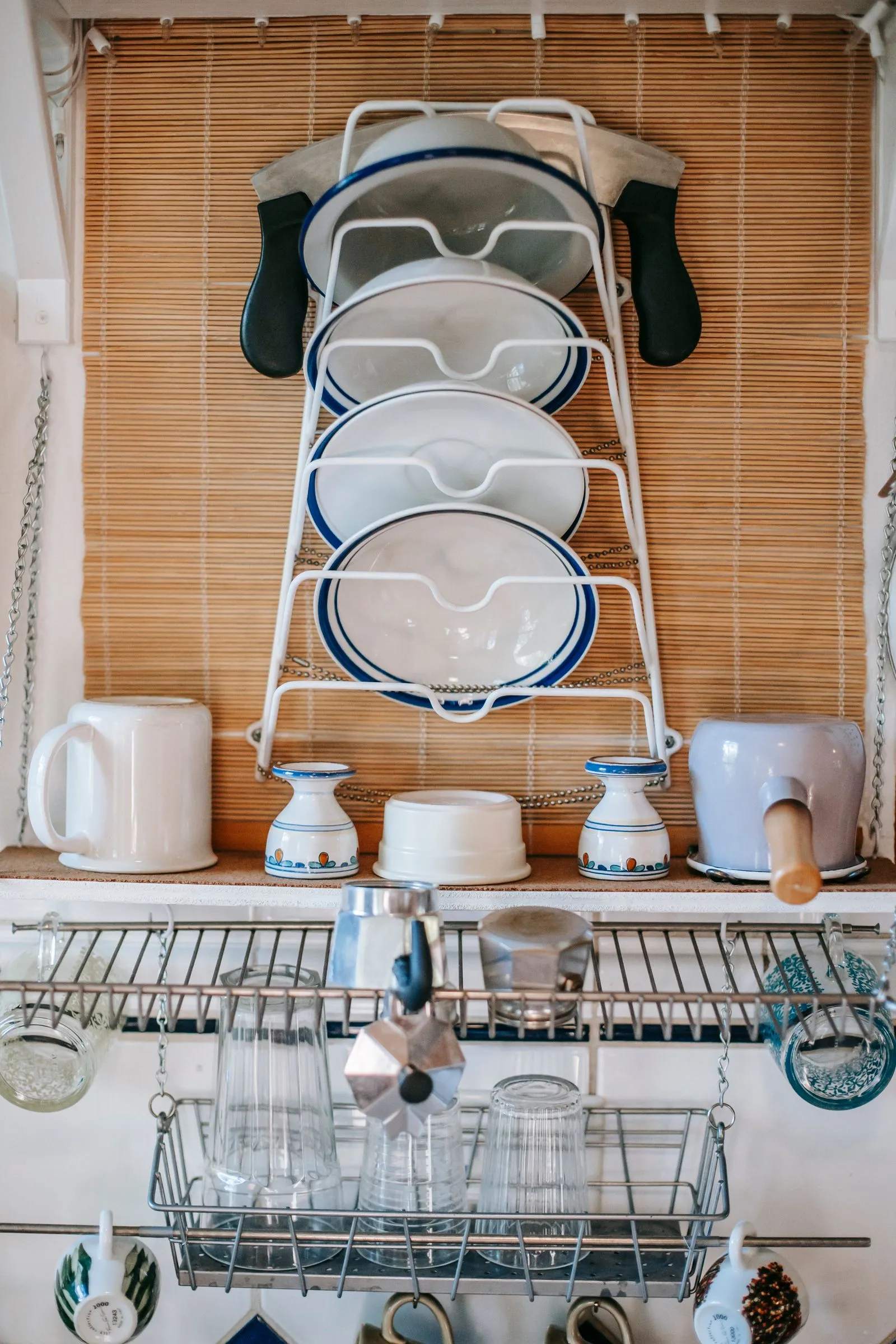
Weight limits matter more than most people budget for. A single L-bracket rated for 25 pounds sags under a shelf of stacked ceramic plates, which run 1 to 2 pounds each and add up faster than expected. For anything holding dishware, use brackets rated for at least 50 pounds per pair, and hit a stud with at least one screw per bracket wherever the wall allows it. A shelf that flexes when you set a bowl down is under-supported, full stop — fix the mounting before loading it further, not after something breaks.
Keep the bottom shelf reachable without a stool, ideally 12 to 15 inches above the counter, since that is the zone that gets used at every meal. Everything else can climb higher. If cabinet doors were making the countertop feel cramped, the guide to countertop clutter solutions for tiny kitchens covers what to clear off the counter first so the new shelves have something worth holding.
Hanging rails and hooks for utensils
A wall-mounted rail, usually a 24- to 36-inch rod with S-hooks, clears an entire utensil drawer’s worth of items off the counter and puts them at arm’s reach beside the stove. It costs $10 to $20 for a basic rail and mounts with two screws in 15 minutes.
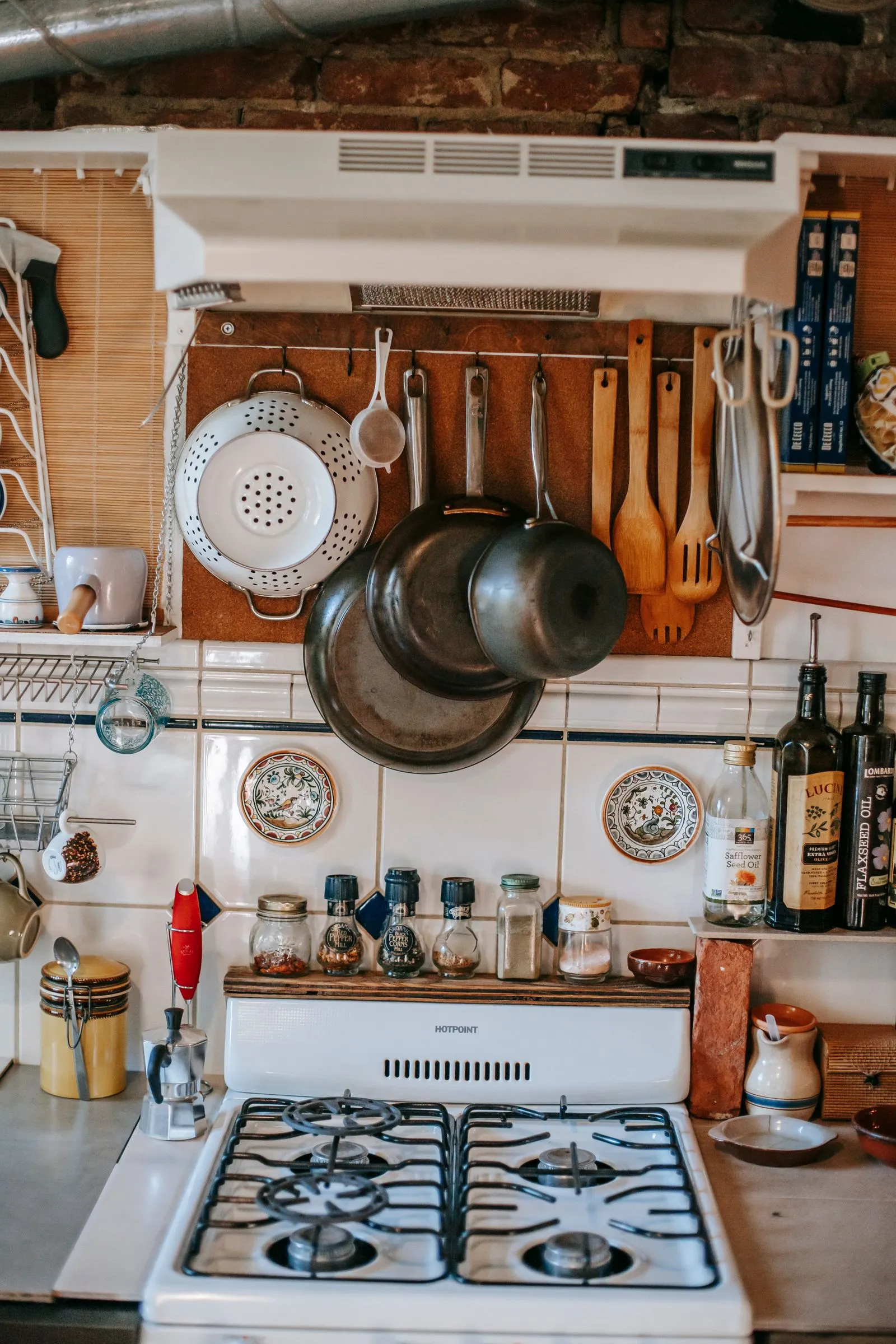
Hang by frequency of use, not by category. The spatula, the tongs, and the ladle that get grabbed every night belong on the rail at eye level. A colander or a rarely used whisk can sit lower or on a second, shorter rail. Leave at least 3 inches between hooks so handles do not tangle when you reach for one mid-cook.
Skip anything that drips or stays wet, like a strainer straight out of the sink. Hang it to dry over the sink first, then move it to the rail once it is dry, or the wall behind it ends up with a permanent water stain.
Pegboard or magnetic strips for tools and knives
A 2-foot-square pegboard panel turns one flat section of wall into fully reconfigurable storage — hooks move whenever the lineup of pots and pans changes, which a fixed shelf cannot do. It runs $15 to $25 for the panel plus a pack of hooks, and it is the single best option for a kitchen where the gear changes with the season, like holiday baking pans that show up for six weeks a year.
A magnetic knife strip solves a narrower problem: knives in a drawer dull faster from banging against other utensils, and a knife block eats 6 to 8 inches of counter a small kitchen cannot spare. A 12- to 18-inch magnetic strip mounted beside the stove holds a full knife set vertically in the same footprint as one dinner plate. Mount it at least 4 inches above the counter so a knife lifted straight up clears the surface instead of scraping across it.
Top-of-cabinet and fridge-top zones done right
The gap above standard upper cabinets, usually 12 to 18 inches to the ceiling, and the flat top of the refrigerator are both storage a small kitchen already owns and usually wastes. The catch is that both zones are hard to reach, so they should hold backstock, not daily items.
Uniform bins or baskets work better here than loose stacking. A matched set of 3 or 4 baskets holding paper towel backstock, extra dish towels, or rarely used bakeware looks intentional and keeps a step stool trip productive instead of a rummage. Anything heavier than a full bin of canned goods, roughly 15 to 20 pounds, should not go above head height at all — a fall from the top of a fridge covers real distance and real force by the time it lands on a counter or a foot.
Skip this zone for anything used more than once a week. If a stool comes out every time the item is needed, it is in the wrong zone and belongs on a lower shelf instead.
Renter-friendly mounting options
Most of what makes vertical storage work does not require drilling into a wall you do not own. Command-brand hooks and strips rated for 5 to 15 pounds handle a light utensil rail, a small spice shelf, or a magnetic strip’s mounting plate, and they come off cleanly with no patching needed at move-out. Tension-mounted shelves and rods brace between counter and cabinet or wall to wall with spring pressure alone, no hardware at all.
For anything heavier, like a loaded open shelf, check the lease before assuming drilling is off the table — many landlords allow small anchor holes as long as they are patched before move-out, which takes five minutes with a tube of spackle. For the load limits and adhesive-strip playbook in more detail, the damage-free wall storage ideas for renters guide covers exactly what holds what weight without a drill.
The habit that keeps the walls working
Vertical storage fails the same way empty cabinets did: one item gets set down in the wrong spot because it was faster, and within a month the shelf that was supposed to hold plates has a phone charger and a stack of mail on it too.
Once a week, scan every wall zone for anything that migrated there without a category — mail on the open shelf, a random tool hooked on the utensil rail, a grocery bag parked on top of the fridge instead of unpacked. Move it to its actual home or find it one on the wall map from step one. That five-minute scan is what keeps a kitchen with almost no cabinets running like one with twice the storage, because every square foot of wall is still doing exactly the job it was assigned.