Under-Cabinet Storage Ideas That Free Up Counter Space
The mugs live on the counter because the cabinet above them is full of plates. The paper towel roll stands next to the stove because there is no other flat spot for it. The wine glasses sit out because they are too tall for the shelf they came with. None of it is clutter exactly — it is just displaced, one item at a time, until the counter is doing storage duty instead of prep duty.
Every one of those items is small enough and light enough to hang, not sit. And every kitchen with upper cabinets has a strip of air running the length of them that never gets used: the 15 to 18 inches between the countertop and the bottom of the cabinet doors. That gap already exists. It is not extra construction, not a new cabinet, not lost floor space — it is space the kitchen has been wasting since the day it was installed. It is also a different zone than the open wall space covered in our guide to vertical storage for small kitchens: this is everything that hangs below the cabinets, not what mounts above or beside them.
Measure the gap before buying anything
Stand at the counter and measure straight up to the bottom edge of the upper cabinets. Most runs land between 15 and 18 inches, though a range hood or microwave nook can pinch that down to 12 inches in spots. Write down the narrowest measurement in the kitchen, not the most generous one, since that is the number that decides what fits everywhere.
Anything mounted under a cabinet needs at least an inch of clearance below whatever it holds, so a stack of mugs on a hook rail needs roughly 5 inches of hanging room, and a stemware rack needs enough drop for the tallest wine glass in the house plus an inch to spare. Check the cabinet door swing too: a mounted rack that sits too far forward will clip an open door and eventually crack the hinge.
Weight matters as much as clearance. Most cabinet bottoms are quarter-inch plywood or thin particleboard, not load-bearing lumber, so anything screwed in should stay under 5 to 8 pounds per mounting point unless you can confirm a solid panel. Adhesive-mounted hardware should stay lighter still, generally under 3 pounds per strip. This is why the systems below are built around distributing light loads across several small mounts instead of hanging everything from one hook.
Undershelf baskets turn one shelf into two
Inside the cabinet itself, a wire undershelf basket clips onto the front lip of an existing shelf and hangs down into the dead air below it, without touching the shelf underneath. It is the single fastest way to add capacity to a cabinet that already looks full, because it uses space between two shelves that was never assigned to anything.
A standard undershelf basket runs about 10 to 15 inches wide and 4 to 6 inches deep, and most clip on in under a minute with no tools, sliding over the shelf edge and locking in place with two hooked arms. Use one to hold napkins, foil and plastic wrap boxes, or a stack of dish towels — anything flat and under about 5 pounds. Skip it for anything with sharp corners that could snag the wire, and stop loading before the basket tips the shelf lip forward.
Hooks under the cabinet clear the mug shelf
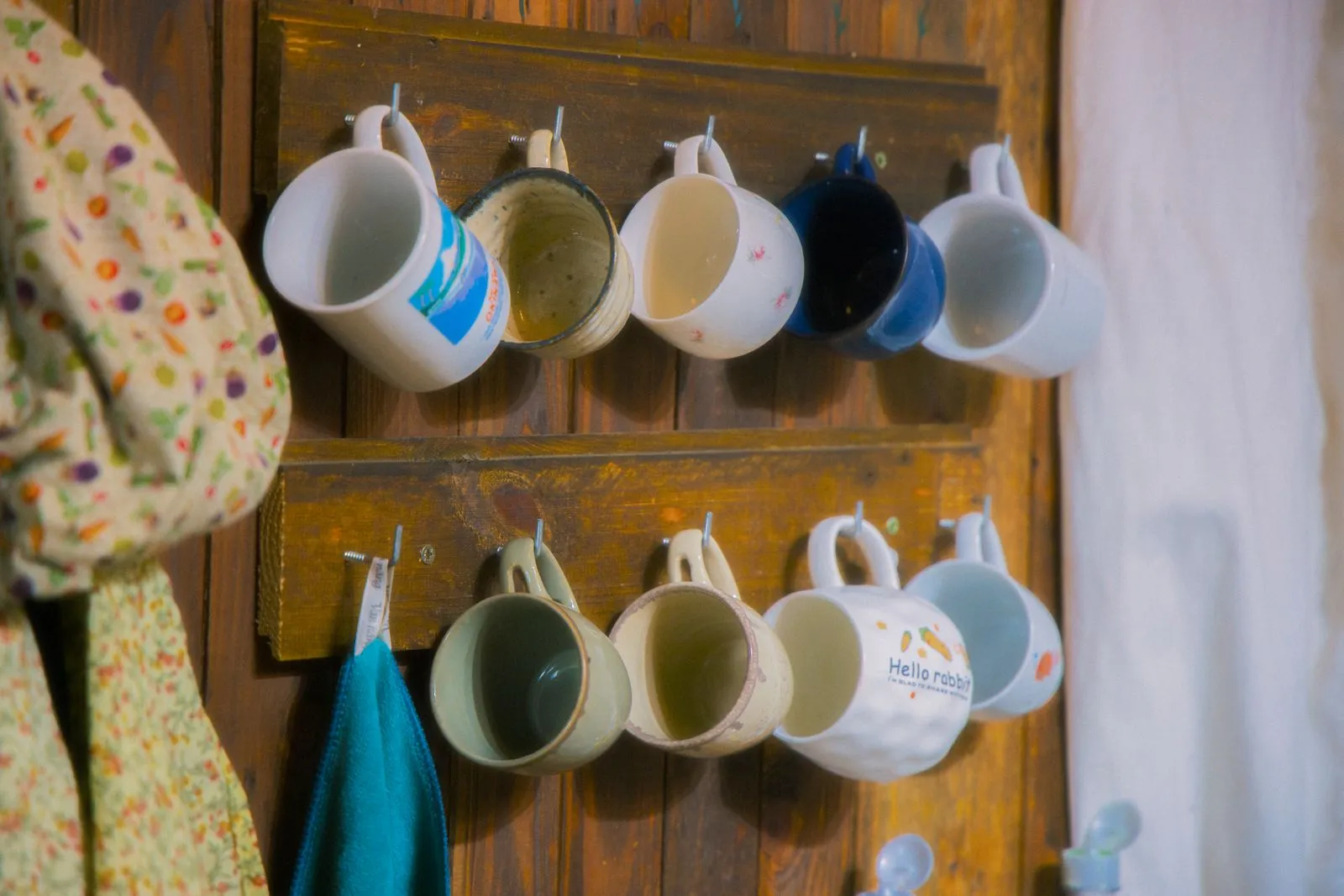
Mugs are one of the worst space-to-frequency trades in a small kitchen: they take up an entire shelf, get used every single day, and rarely stack cleanly because handles point in different directions. Moving them to hooks screwed or stuck to the underside of the cabinet solves both problems — they come off the shelf entirely, and each one hangs by its handle with nothing touching the mug next to it.
A strip of 6 to 8 hooks, spaced about 2 inches apart, clears an entire mug shelf and puts every mug within reach without opening a single door. Keep the everyday mugs on the rail closest to the coffee maker and move anything used less than weekly — the novelty mugs, the extras from a set of twelve — back into a cabinet. That freed-up shelf is real capacity: a full row of upper-cabinet space that used to hold nothing but mismatched handles.
Stemware racks free a whole shelf of glasses
Wine glasses are the other repeat offender: tall, top-heavy, and usually stored right-side up on a shelf sized for shorter dishware, which wastes height and risks a tip-over every time the cabinet door swings shut. A stemware rack solves this by flipping the problem — the glasses hang upside down from their stems, using the vertical drop under the cabinet instead of shelf footprint.
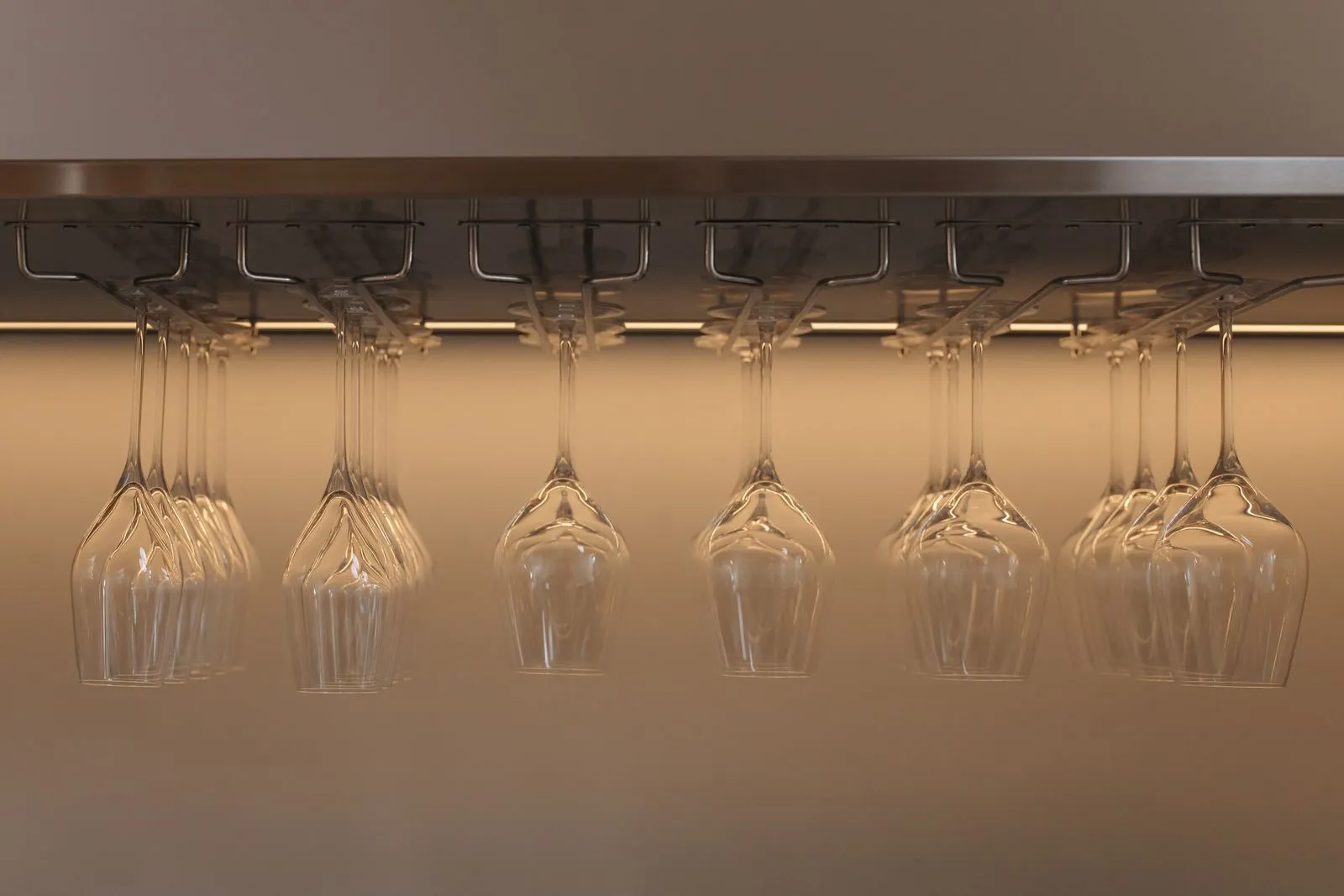
A basic wire or metal stemware rack is 12 to 24 inches long and mounts with 4 to 6 screws, or with rated adhesive strips if drilling is off the table. Measure your tallest glass before buying — a standard wine glass needs about 8 to 9 inches of hanging clearance, and a larger red-wine bowl can need closer to 10. Hung this way, the glasses also stay dust-free between uses, since nothing settles inside a glass that hangs mouth-down.
A paper towel holder gets the roll off the counter
A paper towel roll standing on the counter takes up a 5-inch circle of prep space and tips over the first time a cabinet door bumps it. Mounting a holder to the underside of a cabinet, usually right beside the sink, moves it into the dead zone and puts the towel exactly where a spill happens.
Under-cabinet paper towel holders mount with 2 to 4 screws or a rated adhesive plate and cost very little. Position it so the roll hangs with at least 2 inches of clearance from the counter and away from the stove, since heat rising off a range can scorch the bottom sheets over time. This one swap alone tends to reclaim more usable counter footprint than any other single item on this list, simply because a standing roll is wider than almost anything else that lives on a counter — the same logic behind sorting appliances by frequency of use in our countertop clutter solutions for tiny kitchens guide.
Renter-friendly ways to do all of this without drilling
None of these systems require a drill. Rated adhesive hooks and strips, the kind built for 3 to 5 pounds, hold a mug rail or a paper towel holder cleanly and come off at move-out without taking paint with them, as long as you follow the cure time on the packaging — most need 24 hours of set time before any weight goes on. Tension-mounted stemware racks brace between two points with spring pressure instead of hardware, which works well under a cabinet since the two mounting surfaces are usually close together.
For heavier setups, or if the lease allows small anchor holes, a few screws into the cabinet bottom hold more weight and stay put through years of daily use. Either way, test any adhesive mount for a full day with nothing loaded before trusting it with actual dishware — a strip that is going to fail usually starts peeling at one corner long before anything falls.
The habit that keeps the counter clear
None of this holds up without a two-minute habit: every time a mug, a glass, or the paper towel roll comes off its new hook or rack, it goes back to the same spot, not down on the counter “just for now.” The counter creeping back into clutter always starts the same way — one item set down because putting it away felt like an extra step.
Do a quick scan once a week: is anything sitting on the counter that has a hook or a rack waiting for it underneath the cabinet? If so, that is not a storage problem anymore, it is a habit slipping. Move it back, and the strip of air under the cabinets keeps doing the job the counter used to do — quietly, for free, in space the kitchen had all along.