Holiday Decor Storage Solutions for Ornaments and Lights
Every January the same box comes down from the shelf, and every January it is the same mess: a tangle of string lights with three dead bulbs, two ornaments broken from being stacked under something heavier, a wreath crushed flat on one side because it spent eleven months under a bin of gift bags. None of that is bad luck. It is what happens when decorations go into storage loose, in whatever box was on hand, with no structure to keep them apart.
The fix is not more storage, it’s the right kind, sized to what you actually own, so ornaments cannot knock into each other and lights cannot knot themselves into a ball. Below is a system that fits a small apartment: what to cull first, how to divide ornaments, how to handle lights and wreaths, and where the bins go when closet space is tight.
Cull before you pack anything away
Unwrapping a broken ornament in December is worse than not having it at all, so the culling happens now, while everything is already out.
Pull every decoration from last year’s box and sort into three piles: keep, repair, toss. A cracked glass ball, a strand with a melted plug, or a wreath with bare patches of wire showing goes in the toss pile immediately, since storing it again just means unwrapping the same disappointment next year. Fix what’s repairable, like a loose ornament cap or one burned-out bulb section, now while the parts are in front of you, not in December with company arriving in an hour.
Count what survives. That number decides the size and count of the bins below, so do this step before you buy anything.
Ornament bins with dividers
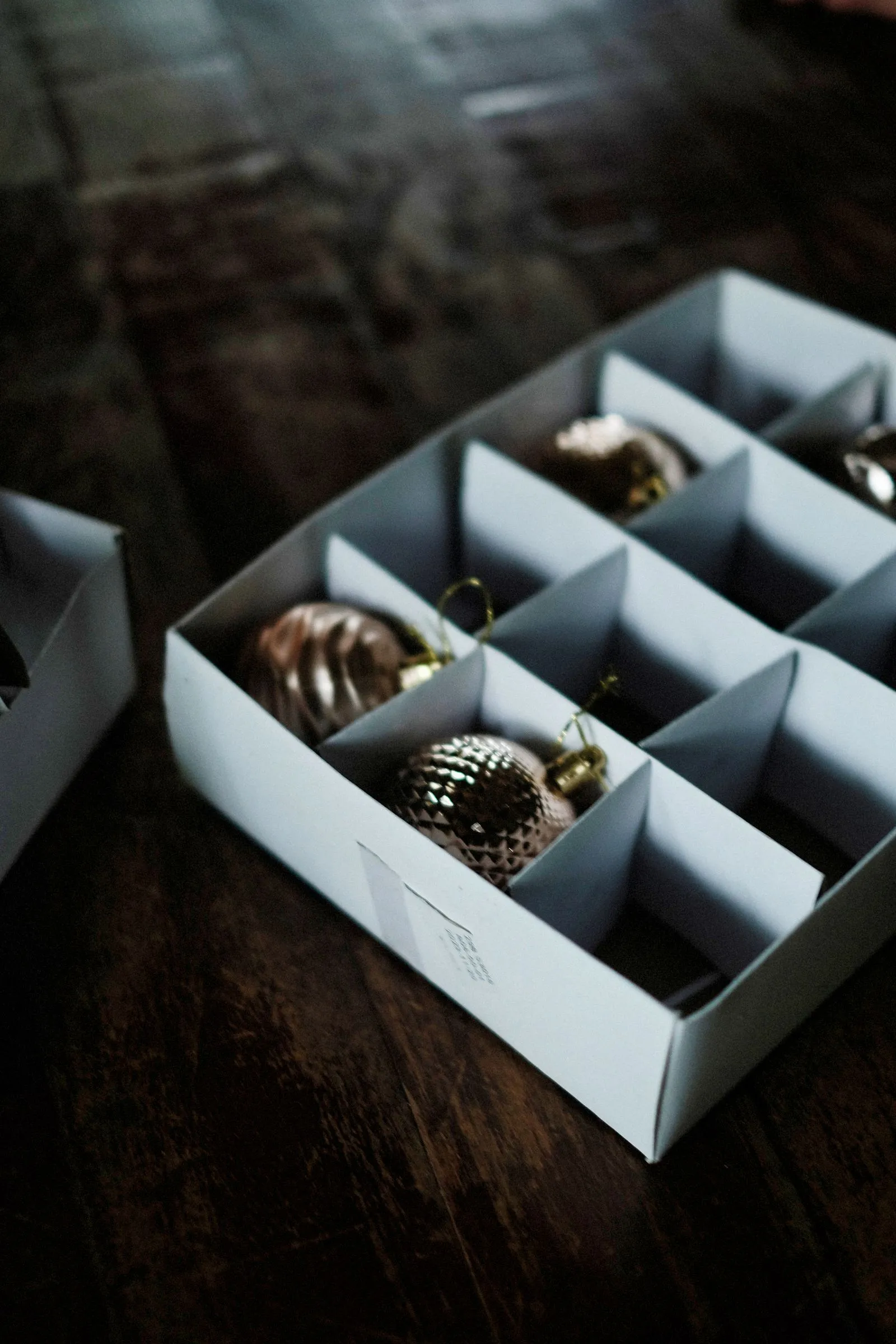
Loose ornaments in a plain box move every time the box moves, and glass balls touching each other is how chips and cracks start. A divided container solves this by giving each ornament its own cell.
A dedicated ornament storage box typically holds 64 to 75 pieces in a grid of cardboard dividers inside a container roughly 15 by 15 by 12 inches, and runs 15 to 25 dollars. Buy based on your actual count from the cull, rounding up to the next size rather than cramming extras into a full box.
The DIY version costs almost nothing. Cut strips of corrugated cardboard as wide as a sturdy box or bin is deep, then notch each strip halfway through so they interlock into an egg-crate grid, typically nine to sixteen cells for a 12-inch box. Wrap glass ornaments in tissue paper before setting them in a cell, and put the heaviest pieces on the bottom layer if you stack two layers of dividers.
Separate by weight and material rather than theme. Glass goes in its own divided layer, never touching another glass piece. Plastic, wood, and fabric ornaments can share a bin since they survive contact, freeing the divided box for glass exclusively.
Light storage that does not end in a knot
String lights tangle for one reason: they go into the box as a loose coil with nothing holding the shape. Unwinding that coil is where bulbs get cracked and wires get pulled loose from their sockets.
A cord reel is the fastest fix. Plastic light-wrap reels run about 3 to 8 dollars each and hold 100 to 300 feet of mini lights, wound flat around a spool with a slot to tuck the plug end. Wind while unplugging the strand, not after, so you are not fighting a live cord.
The no-purchase version works just as well. Cut a rectangle of stiff cardboard about 12 by 6 inches, notch both ends so the wire catches, and wind the lights around it the way you’d wind a garden hose around your palm and elbow, securing the plug end last. One board holds one strand cleanly, so label it with the strand’s length and bulb color before it goes in the bin.
Test every strand before wrapping it. A strand that goes in dark stays dark, and you will not find out until the tree is already up. Group the working strands together and set the dead ones aside for repair or disposal rather than mixing them into next year’s box.
Wreath storage that keeps the shape
A wreath stored flat under weight comes out with one crushed side that never fully rounds back, and one crammed into a garbage bag gets its branches bent in every direction.
A dedicated wreath storage bag, 24 to 30 inches across, hangs the wreath upright on its own hook inside a zippered case, the only method that keeps the shape completely true. These run 12 to 20 dollars and are worth it for an artificial wreath you plan to keep for years.
Without a hanging bag, a flat cardboard wreath box roughly 24 by 24 by 5 inches works if you lay the wreath in undisturbed and never stack anything on top. Loosely stuff the center hole and outer edge with tissue paper so the branches hold their curve instead of settling flat. The cheapest option is a hook on the inside of a closet door for the off-season, which costs nothing and keeps the wreath where nothing can crush it.

Where it all fits in a small home
Holiday decor is the definition of bulky and seasonal, which makes it the best candidate for the storage spots that are dead space the rest of the year.
Under the bed. A shallow under-bed bin, about 30 by 20 by 6 inches, holds one to two divided ornament layers or a flattened wreath box. Measure clearance before buying, since platform beds often give only 5 to 7 inches, and a bin that won’t slide under sits in the hallway all year.
Closet top shelf. The highest shelf in a coat or hall closet, usually 12 to 14 inches deep, is built for containers you touch twice a year. A 16-by-12-by-12-inch bin fits most standard shelves and lifts down one-handed.
Vertical bins on the closet floor. If floor space is open, stack two or three ornament boxes against a side wall rather than spreading them out. A stack of 15-inch boxes three high uses about two square feet and clears the rest of the closet for its other ten months of use.
Keep light reels in a separate, smaller bin from the ornaments. Lights get pulled out first when decorating starts and put away last when it ends, so a bin you can grab without unstacking everything else saves real time on both ends of the season.
A labeling system that survives eleven months
A label is only useful if you can read it without opening the box, and it stays accurate only if updating it is as easy as writing on the original.
Label the short end of every bin, not the top, since boxes get stacked and the top disappears. Use a paint pen or a printed label rather than marker on cardboard, which fades within a year in a garage or attic. Write contents specifically: “Ornaments — glass, red and gold” tells you more than “Christmas,” and lets you grab the one bin you need instead of opening three.
Add the count when you pack the box, something like “68 ornaments, 2 replaced.” Next year, unpacking starts with a known number instead of a guess, so you notice right away if something is missing or broken.
Mistakes that undo all of this
Skipping the tissue paper on glass ornaments, and skipping climate control. Bare glass against a cardboard wall chips on a bumpy move, and an unheated garage or attic cracks it over a few seasons of temperature swings. Wrap fragile pieces and store them inside the living space, in a closet or under the bed.
Storing lights plugged into each other. Strands left connected end to end tangle into one long problem instead of several small ones. Unplug and wind each strand separately.
Stacking anything on a wreath box. Even a few minutes of a heavier bin sitting on top permanently flattens artificial branches.
Buying bins before counting what you have. A box sized for forty ornaments and a count of sixty-eight means a second trip to the store and decorations sitting in the hallway in the meantime.
Set it up once, in under an hour
Do the cull first, since it decides every size below it. Sort survivors into glass, non-glass, lights, and wreath. Pack glass into a divided box with tissue between pieces, wind each light strand onto its own reel or cardboard, box or bag the wreath without weight on top, and label every container on the short end with contents and count.
Put it away wherever it fits: under the bed for bulk, the closet top shelf for the light bin you grab first, vertical stacks on the closet floor if there’s room. The whole system takes less time than one bad hour untangling lights in December, and it only has to be done once to keep working every year after.
If gift wrap is the other half of your December closet problem, the upright organizer and bin sizing in our guide to gift wrap storage keeps rolls and ribbon from tangling with the ornament bins you just packed.