Shower Caddy and Tension Pole Storage for Renters Who Can't Drill
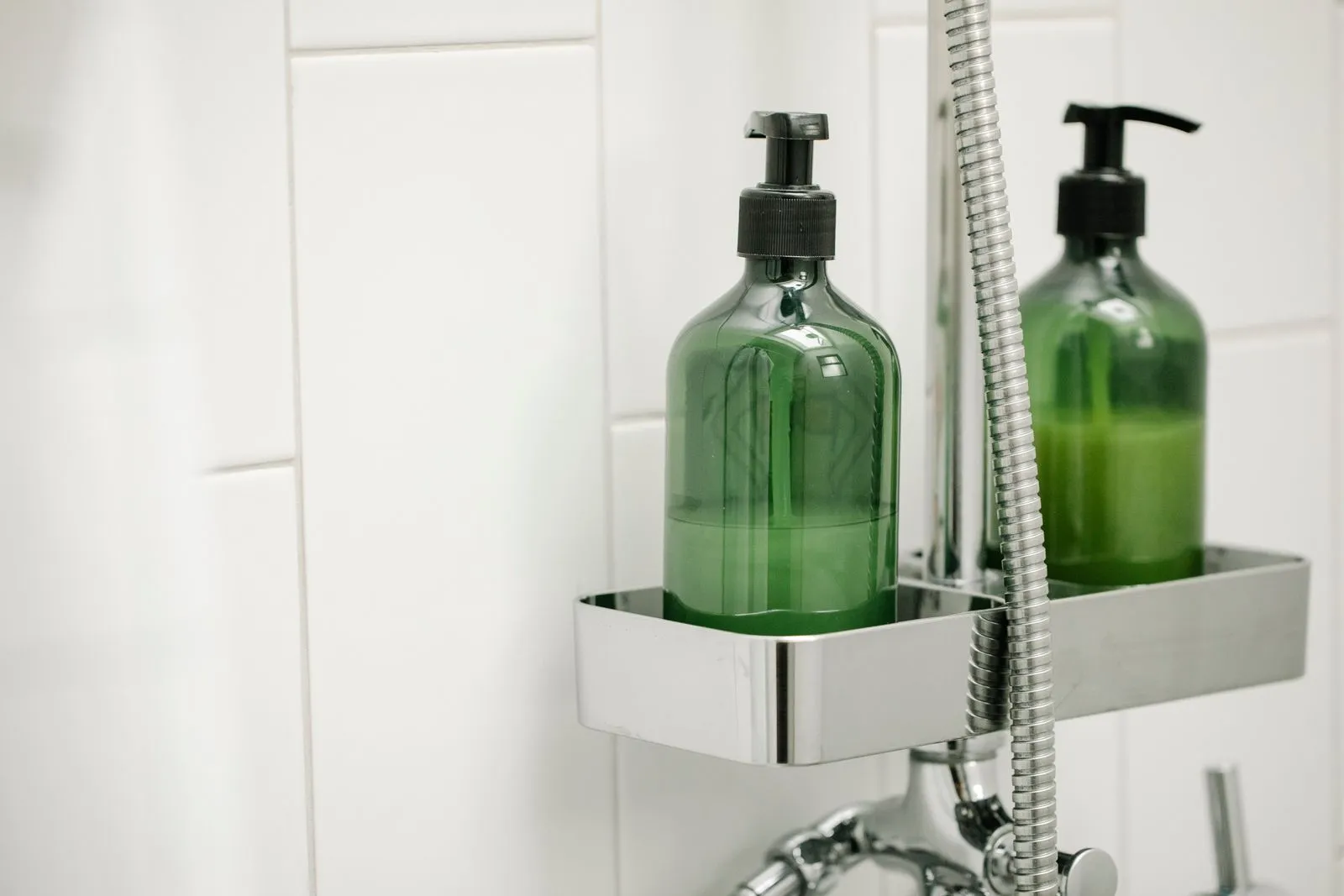
Three shampoo bottles, a conditioner, and a razor are lined up on the 4-inch ledge at the back of the tub. Every time someone reaches for the body wash, one bottle tips into the water. The ledge was never meant to hold six things. It was meant to hold none.
That is the default state of a rented shower: no shelf, no niche, no built-in storage, and a lease that says nothing gets drilled into the tile or the fiberglass surround. It does not have to stay that way. A tension pole with a couple of wire shelves creates a full vertical storage column inside the shower, and it goes up and comes back down without a single screw, anchor, or drop of adhesive.
The four no-drill options, compared
Tension pole caddies wedge between the tub floor and the ceiling (or between two walls in a stall shower) using spring pressure, and shelves clip onto the pole at whatever height works. They hold the most weight, fit almost any shower height between 82 and 92 inches, and don’t depend on the shower system at all. The tradeoff is a visible pole running floor to ceiling, which some renters find intrusive in a small stall.
Over-showerhead caddies hang their weight from the shower arm itself, using a bracket that loops over the pipe before the showerhead screws back on. No pole, no suction, no adhesive — just gravity and the pipe’s own strength. They hold less than a tension pole, capping around 10 to 15 pounds, and only work if there’s a straight shower arm to hang from. Some models hedge that last requirement — Umbra’s Flex Shower Caddy mounts over the shower head or onto the curtain rod, so a curved or stubby arm doesn’t rule it out, and its 25.5-inch frame uses an integrated draining system rather than a solid tray that holds water.
Suction caddies stick to smooth tile or glass with vacuum cups and can go anywhere within reach. They’re the cheapest option, often $8 to $15, and leave zero marks. They’re also the least reliable: suction fails on textured tile or grout lines, and a fully loaded shelf can peel off overnight without warning.
Adhesive-strip caddies use a mounting strip instead of suction, which holds better on tile but still transfers off cleanly if it’s a lease-safe strip rated for removal. They’re a solid middle ground, but the strip still needs a smooth, non-textured surface, so it fails on the same rough tile that defeats suction cups.
For a shower shared by more than one person, or anywhere the walls aren’t smooth glass, the tension pole wins on capacity and reliability. The rest of this guide focuses on getting one set up right.
Measuring before you buy
The most common tension pole mistake is buying one too short or too long for the space, which leaves it wobbly instead of wedged tight. Measure floor to ceiling at the exact spot the pole will stand, not a guess from across the room — ceilings in older apartments can vary by an inch or more corner to corner.
Most adjustable poles extend from about 82 inches to 92 or even 108 inches, covering nearly every residential ceiling. Buy one rated for at least 2 inches more than your measured height, since that extra range is what creates the spring pressure holding it in place. A pole maxed out at its exact measured height has no tension left to grip with.
Check the corner too. A tension pole needs to sit flush where two walls meet, or braced against the tub’s back wall, to avoid twisting. A sloped tub bottom or curved corner will make a flat-footed pole rock instead of standing solid.
Installing it in 15 minutes
Start with a dry tub or shower floor — wet fiberglass is slippery enough that the pole’s rubber foot can skid while you adjust tension. Extend the pole to roughly the right height by hand, stand it in the corner, then twist the locking collar (or turn the pole itself, depending on the model) to extend it the last inch or two against the ceiling.
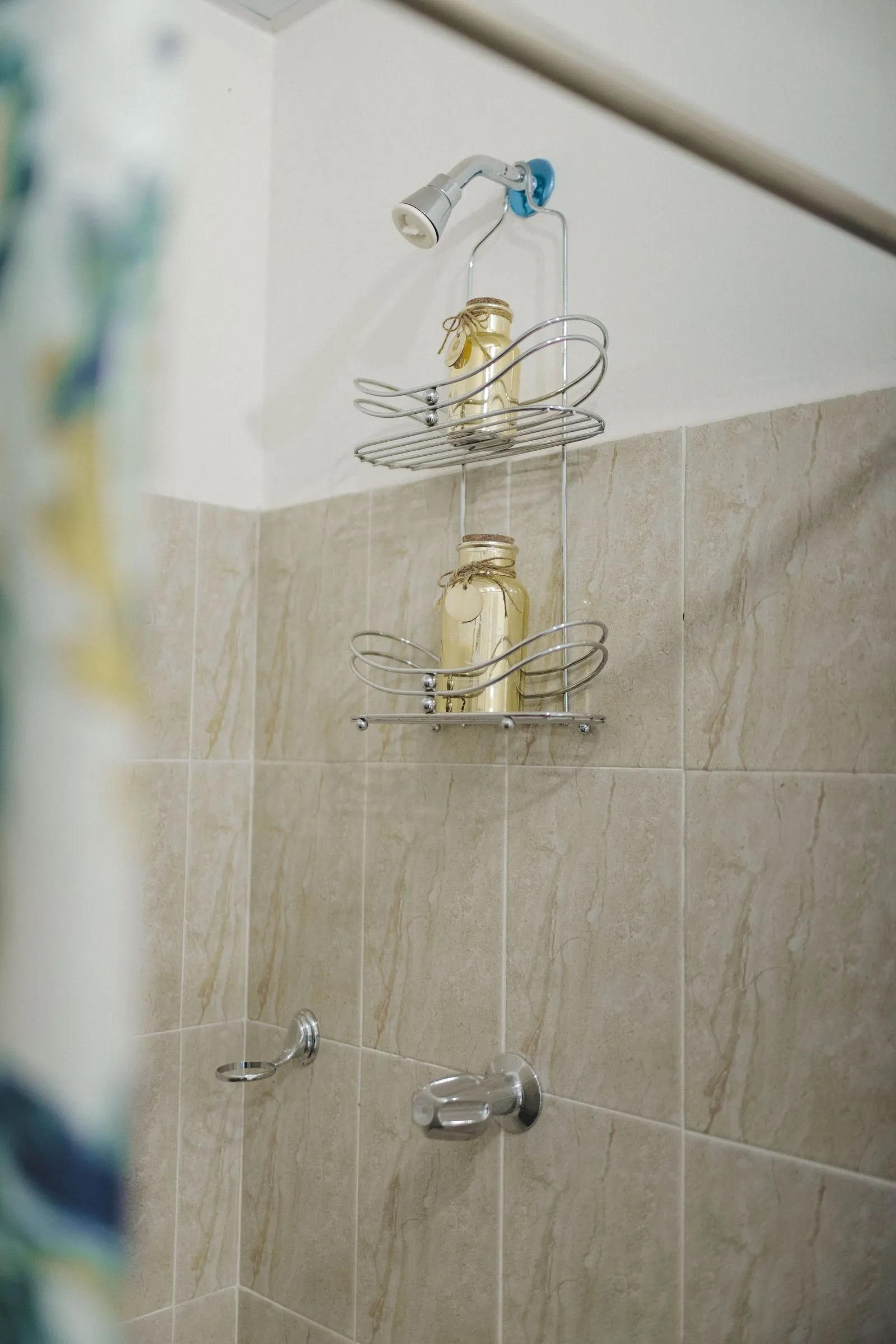
Push up on the pole once it’s locked — it should not budge, slide, or rotate freely. If it gives at all, extend it another half inch and test again. Once solid, clip on the wire shelves starting from the bottom, spacing them so the tallest bottle still has an inch of headroom. Most poles ship with 3 to 4 shelves; an empty shelf can go into a linen closet instead of taking up shower space for nothing.
The bottle cull and the one-in-one-out rule
A tension pole with four shelves can hold 15 or more bottles, which sounds like a feature until half are near-empty travel sizes and dead-end conditioner samples nobody will finish. Before loading the caddy, line up everything currently in the shower and cut anything under a quarter full that isn’t used daily — combine duplicates into one bottle and toss the rest.
Going forward, use a one-in-one-out rule: a new bottle only enters the caddy when an old one of the same type is finished and recycled. This caps the shelf count permanently instead of letting it creep back up to fifteen. A caddy with four shelves supporting four roommates’ daily products, one shelf each, works far better than one person’s bottles sprawling across all four.
Draining and rust prevention
Wire shelves that hold standing water at the bottom of each rung will eventually rust, even on caddies advertised as rust-resistant, because the coating wears fastest where a bottle rim rests. Look for slotted or mesh bottoms rather than solid trays, so water runs through instead of pooling.
Wipe the shelves dry once a week as part of a regular bathroom pass, and turn any bottle with a wet base upside down for a few seconds before setting it back. If rust spots do appear on a chrome-finish caddy, a plastic or powder-coated version handles humidity better long term, even though chrome looks cleaner in the store.
Zoning a shared shower
In a shared apartment, an unzoned caddy turns into a pile within a week — everyone’s stuff mixed on every shelf, nobody sure whose bottle is whose. Assign one shelf per person from the start: top shelf for whoever showers first and wants fast access, bottom shelf for whoever showers last and has time to reach lower.
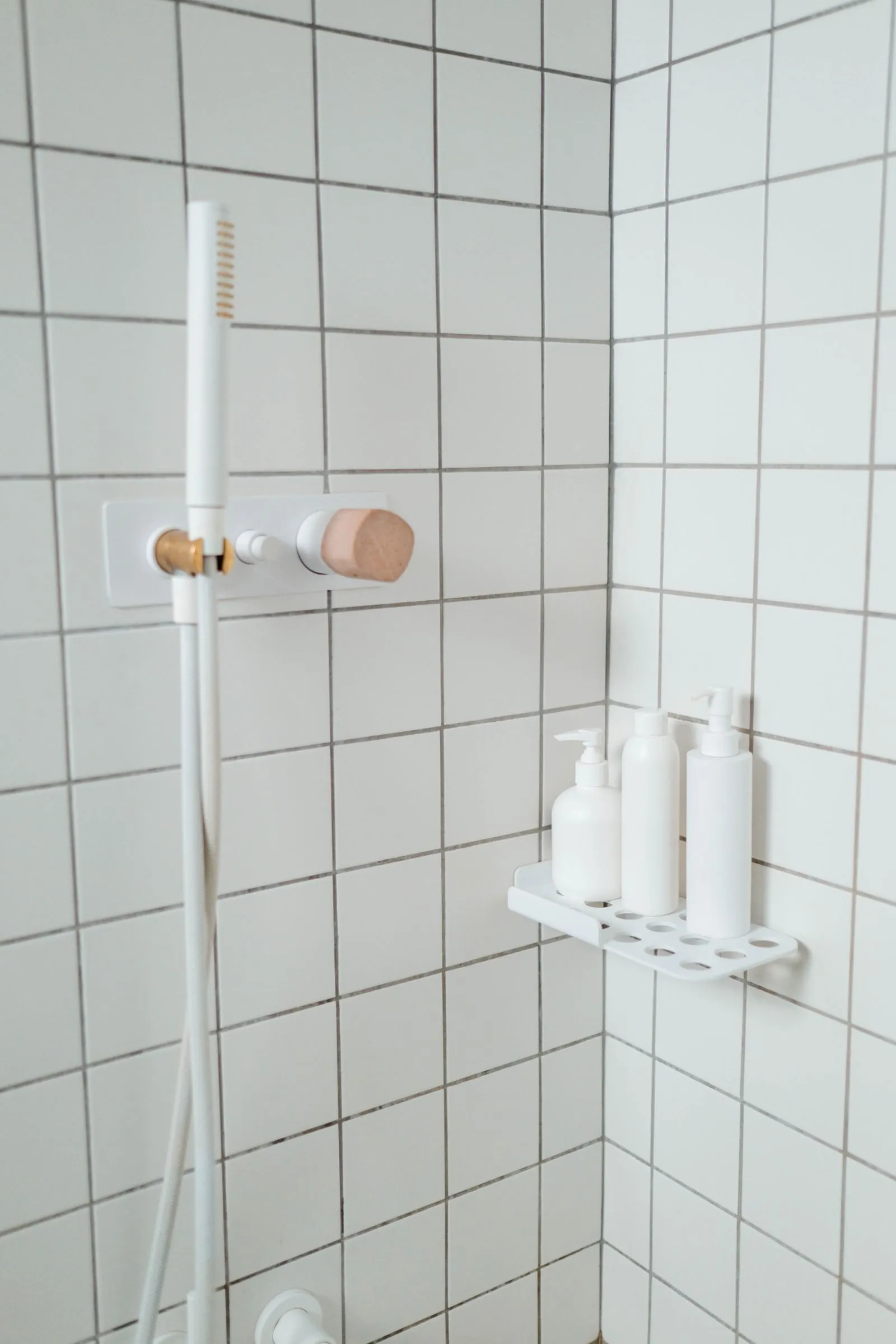
Shared items — a communal soap bar, a razor caddy, a shower brush — get their own designated shelf or hook instead of drifting onto whichever shelf has space. A bottom hook or bar is the spot for a loofah or wash mitt that needs to air out, since it shouldn’t live tangled with anyone’s shampoo. For more on splitting territory in a bathroom with heavy daily traffic, see our guide to small bathroom storage ideas that are renter-friendly.
The renter move-out checklist
Because the whole system runs on tension and hooks instead of adhesive or screws, moving out is close to instant. Unclip the wire shelves from the pole first — leaving them attached while you remove the pole risks a shelf swinging loose and chipping tile. With the shelves off, twist the locking collar to release tension and lower the pole out of the corner.
Check the ceiling and wall contact points for marks. A rubber foot occasionally leaves a faint scuff on painted ceilings after months of pressure; a damp cloth with a little dish soap usually lifts it before a walkthrough. Pack the pole and shelves flat in a moving box — they’ll go right back up in the next place in the same 15 minutes.
The habit that keeps it from sliding back into the tub
None of this holds up without a five-minute weekly check. Look at the caddy and ask three questions: is anything under a quarter full that should be tossed, is any shelf holding standing water, and is the pole still solid when you push on it. Recheck tension specifically after the first month, since rubber feet compress slightly and a pole snug on day one can loosen by week four.
Keep that check running and the caddy stays a real storage system instead of another surface things pile onto. The alternative — bottles balanced on a 4-inch tub ledge, one shove away from the water — is exactly the problem a $15 pole and fifteen minutes were meant to solve. If the rest of the bathroom still needs the same treatment, our guide to under-sink bathroom storage solutions for small cabinets picks up where the shower system leaves off.